Chemistry (O Level)
Chemistry (O Level) is an internationally recognized secondary school science course (Cambridge O Level code 5070) that…
- 0
- 40h 10m
- 0

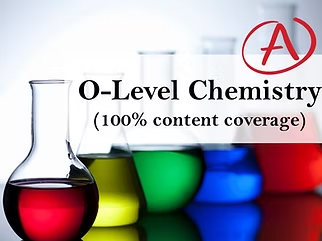
Chemistry (O Level) is an internationally recognized secondary school science course (Cambridge O Level code 5070) that introduces students to the essential principles of chemistry, including the behavior of matter, chemical reactions, and practical laboratory skills. It builds a strong foundation for further science education and helps develop analytical and problem-solving abilities.
📚 Course Details
🔹 Subject Code
-
Chemistry 5070 (Cambridge O Level) — widely used in schools following the Cambridge curriculum.
📘 What You Learn
Students study core chemistry topics that explain how substances interact and change, including:
• States of Matter – properties of solids, liquids & gases
• Atoms, Elements & Compounds – basic structure of matter
• Stoichiometry – chemical formulas and calculations
• Electrochemistry – electrolysis and cells
• Chemical Energetics – energy changes in reactions
• Chemical Reactions – types and rates of reactions
• Acids, Bases & Salts – properties and reactions
• The Periodic Table – trends and element classification
• Metals – properties and extraction
• Chemistry of the Environment – air and water chemistry
• Organic Chemistry – carbon compounds basics
• Experimental Techniques & Chemical Analysis – lab methods and data handling
🧪 Assessment Structure
Students are assessed through three main components:
-
Paper 1 — Multiple Choice
-
1 hour, 40 marks (30%)
-
40 questions to test basic understanding.
-
-
Paper 2 — Theory
-
1 hour 45 minutes, 80 marks (50%)
-
Structured & short-answer questions covering key topics.
-
-
Paper 3 or Paper 4 — Practical Skills
-
Paper 3 (Practical Test): 1 h 30 min, 40 marks (20%) — hands-on lab work
-
Paper 4 (Alternative to Practical): 1 h, 40 marks (20%) — practical understanding without lab
-
Grades awarded: A* to E.
🔬 Skills Developed
-
Understanding chemical principles and terminology.
-
Mathematical problem-solving in chemical contexts.
-
Practical laboratory techniques and data interpretation.
-
Scientific reasoning and analytical thinking.